
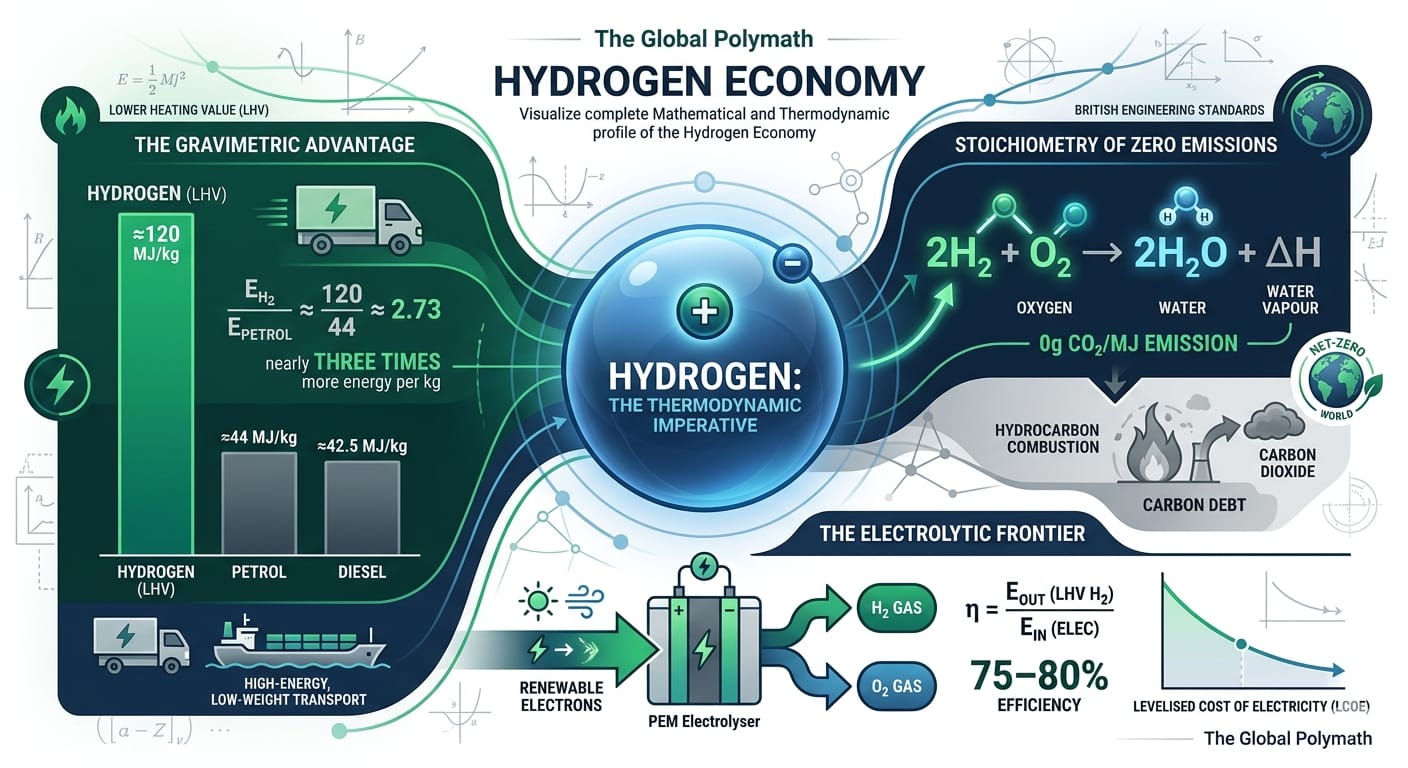
In the quest for a carbon-neutral civilisation, the global community often finds itself entangled in political rhetoric. However, at The Global Polymath, we believe the path to the future is paved with the cold, immutable laws of physics. To understand why hydrogen \(\mathrm{H_2}\) is the ultimate energy carrier for the twenty-first century, one must transcend the abstract and examine the rigorous mathematics of its energy profile.
The Gravimetric Advantage
The most compelling mathematical argument for hydrogen lies in its specific energy — energy per unit mass. When compared to traditional hydrocarbons, hydrogen exhibits an extraordinary gravimetric density that is essential for the transition of heavy industry and long-haul transport.
Consider the Lower Heating Value (LHV) comparison:
| Fuel | LHV (MJ·kg−1) | Carbon at the tailpipe |
|---|---|---|
| Hydrogen \(\mathrm{H_2}\) | ≈ 120 | 0 g CO2/MJ |
| Petrol / Gasoline | ≈ 44 | ~ 70 g CO2/MJ |
| Diesel | ≈ 42.5 | ~ 74 g CO2/MJ |
The numerical insight. The ratio of energy density between hydrogen and petrol is approximately:
Mathematically, this confirms that hydrogen carries nearly three times more energy per kilogram than conventional liquid fuels. For sectors where weight is a prohibitive constraint — aviation, maritime shipping, long-haul freight — this ratio is the primary driver for adoption.
The Stoichiometry of Decarbonisation
The chemical elegance of hydrogen is found in its oxidation reaction. Unlike the complex combustion of long-chain hydrocarbons, which mathematically necessitates the release of carbon dioxide, the hydrogen reaction is fundamentally clean.
where \(\Delta H\), the enthalpy of reaction, is approximately \(-286\;\text{kJ}\cdot\text{mol}^{-1}\) (for HHV).
From a carbon-accounting perspective, the emission factor is exactly \(0\;\text{g CO}_2/\text{MJ}\) — the only mathematical way to achieve a true Net-Zero balance without relying on high-uncertainty offsets.
The Efficiency of the Electrolytic Frontier
The economic viability of green hydrogen is governed by the efficiency \(\eta\) of electrolysis, particularly through Proton Exchange Membrane (PEM) technology. The efficiency of converting renewable electrons into storable chemical molecules is defined as:
Current industrial-scale electrolysers are reaching efficiencies of 75–80 %. When combined with the plummeting Levelised Cost of Electricity (LCOE) from solar and wind — often dropping below \(\$20/\text{MWh}\) in strategic regions — the “green premium” of hydrogen is mathematically converging towards parity with grey alternatives.
The Volumetric Challenge: The Density Dilemma
Transparency demands we acknowledge the inverse of hydrogen's gravimetric success: its low volumetric density. At standard temperature and pressure (STP), hydrogen requires significant energy for compression or liquefaction.
| Carrier · state | Density (MJ·L−1) | Storage challenge |
|---|---|---|
| Gaseous \(\mathrm{H_2}\) (700 bar) | ≈ 5.6 | High-pressure carbon-fibre tanks |
| Liquid \(\mathrm{H_2}\) (cryogenic) | ≈ 8.5 | Boil-off losses; cryostat infrastructure |
| Liquid petrol | ≈ 32.4 | Trivial — ambient liquid |
Solving this density gap is the current focus of materials science, involving advanced carbon-fibre storage and ammonia \((\mathrm{NH_3})\) as a high-density carrier molecule with an energy density approximately three times that of compressed hydrogen at the same volume.
The Polymathic Verdict
The mathematics of hydrogen is not merely a technical detail; it is a roadmap. The high specific energy and clean stoichiometry provide a thermodynamic foundation that no other element can match. As we scale the infrastructure to address volumetric limitations, the transition to a hydrogen-based economy becomes not just a possibility, but a mathematical certainty.
Key Takeaways
- Specific energy
- Hydrogen carries \(\approx 2.73\times\) the energy of petrol per kilogram — the decisive figure for aviation and shipping.
- Carbon coefficient
- The combustion product of \(2\,\mathrm{H_2} + \mathrm{O_2}\) is water vapour. The emission factor is exactly zero.
- Electrolytic efficiency
- PEM electrolysers now achieve \(75\text{--}80\,\%\) energy efficiency — the curve has crossed the line at which renewables-to-hydrogen begins to make fiscal sense.
- The honest caveat
- Volumetric density remains the open problem. Ammonia carriers and 700-bar composite vessels are the working answers; better answers are coming.
Polymathic Links · Deep Dive
Each story on this paper carries three trails outward — into the science, the history, and the law that frame the headline.
- Science The thermodynamics of fuel cells — how chemical free energy becomes electrical work without a heat engine, and why that liberates hydrogen from the Carnot ceiling. Read the primer →
- History From Cavendish (1766) to the first PEM cell at General Electric (1955), the two-and-a-half-century arc of hydrogen as an industrial idea. A short history →
- Law The treaty architecture of carbon: how Article 6 of the Paris Agreement is being read, by whom, and what it means for green-hydrogen credit transfer. Treaty primer →
- Philosophy The ethics of the “bridge fuel” argument — on the moral hazard of intermediate solutions, and where principled patience ends. Editorial: Renewables vs Fossils →
The cover story of this issue argued that the universe, the psyche, and global law are three answers to one question. The scientific review argument is narrower, but of the same family. The question of how a curious species fuels its civilisation is a question of physics, of economics, and of treaty law — in that order, and at the same time. The honest editorial position, this paper has long maintained, is the one that does not flatter either side of the present debate. The mathematics is not a partisan: read it, and the verdict reads itself.
———