William Shakespeare's Hamlet is not merely a play; it is a profound exploration of the human condition, a philosophical labyrinth, and a mirror that has reflected the anxieties of every generation since its first performance around 1600. For over four centuries, the Prince of Denmark has stood as the quintessential archetype of the modern man — torn between action and contemplation, duty and conscience, life and the “undiscovered country” of death.
As we dissect this masterpiece for the readers of The Global Polymath, we delve into why this “revenge tragedy” transcended its genre to become the most discussed, analysed, and performed work in the history of world literature.
The Architect of the Modern Mind
Before Hamlet, characters in drama were often types — the loyal soldier, the wicked villain, the virtuous maiden. Shakespeare broke this mould by giving Prince Hamlet an internal life so vast that it seemed to leak out of the stage and into reality. Hamlet is the first character in literature to possess a “consciousness” that evolves.
The play's central conflict is not just the physical struggle between Hamlet and his uncle, King Claudius, but the cerebral war within Hamlet himself. His famous procrastination — his “delay” — is not a sign of weakness but of a hyper-intellectual mind grappling with the moral consequences of murder. In an age of blind vengeance, Hamlet asks: Is it noble to strike back, or is it a deeper sin to perpetuate the cycle of blood?
“To Be, or Not to Be”: The Existential Pivot
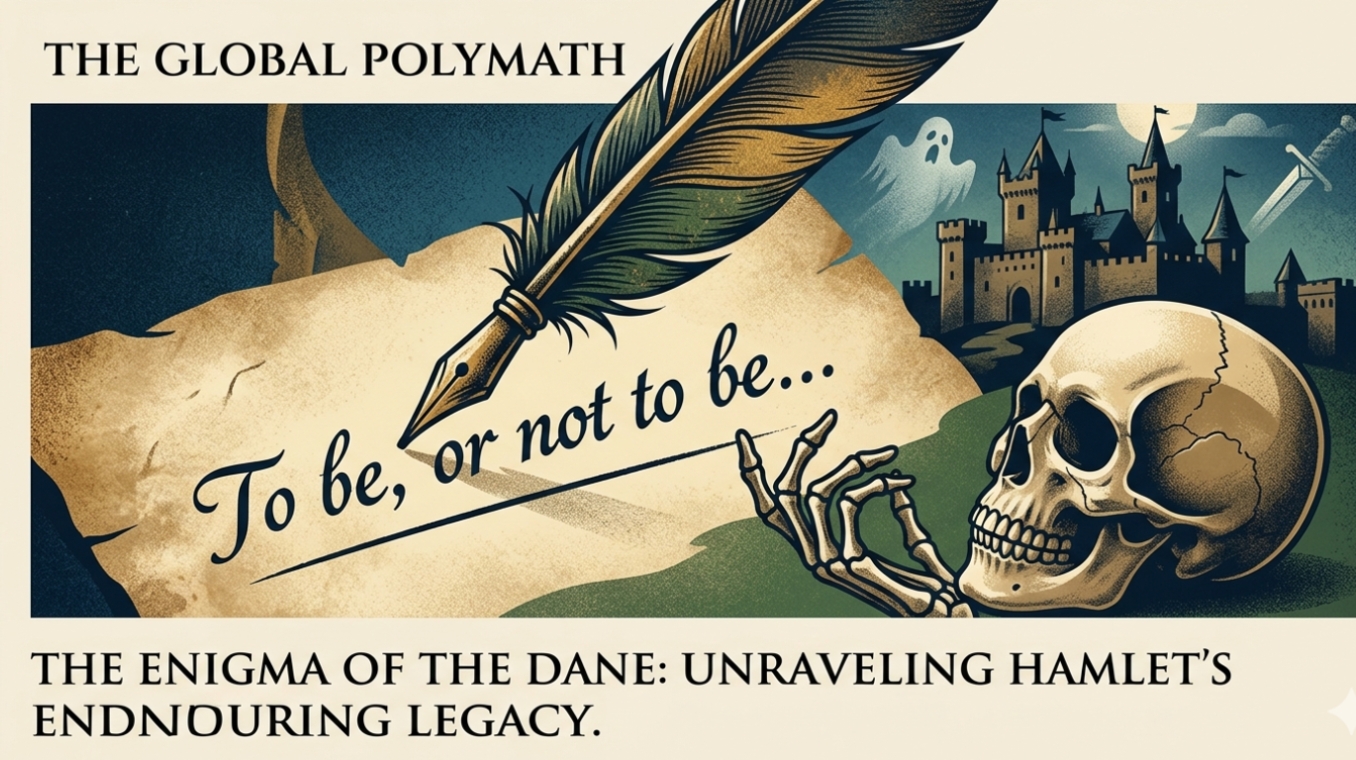
At the heart of the play lies the world's most famous soliloquy. In “To be, or not to be,” Hamlet moves beyond his immediate situation to address the universal struggle of existence. Here, Shakespeare anticipates existentialist philosophy by centuries.
The dread of something after death — the undiscovered country — puzzles the will, and makes us rather bear those ills we have than fly to others that we know not of.
Hamlet weighs the “slings and arrows of outrageous fortune” against the finality of death. This speech resonates globally because it speaks to the fundamental human fear of the unknown. It is the ultimate intellectual inquiry: if life is a series of sufferings, why do we endure it? The answer — the dread of something after death — is a testament to the psychological realism that makes Hamlet an international standard of literary excellence.
A Tapestry of Political and Moral Decay
For a publication like The Global Polymath, which often looks at the intersection of law, power, and society, Hamlet offers a chilling study of political corruption. “Something is rotten in the state of Denmark,” Marcellus famously remarks. This “rottenness” is a metaphor for a diseased body politic where a throne is gained through fratricide and maintained through surveillance.
The court of Elsinore is a place of shadows, where Polonius hides behind tapestries to spy, and Rosencrantz and Guildenstern betray friendship for royal favour. Shakespeare masterfully illustrates how personal moral failings — specifically Claudius's ambition — infect an entire nation, leading to a climax where the “state” essentially collapses under the weight of its own secrets.
The Women of Elsinore: Ophelia and Gertrude
An international critique of Hamlet must address its complex, often tragic, portrayal of women. Gertrude and Ophelia are frequently seen as victims of the male-dominated world of Elsinore.
- Gertrude Her “o'er-hasty marriage” is the catalyst for Hamlet's disillusionment. Is she a complicit conspirator or a woman seeking survival in a volatile political climate? Shakespeare leaves her ambiguity intact, allowing every era to reinterpret her.
- Ophelia Her descent into madness remains one of the most haunting sequences in theatre. Ophelia represents the collateral damage of patriarchal power plays. Her “flowers” speech is a coded linguistic protest against a court that silenced her.
The Language of the Polymath
Technically, Hamlet is a linguistic marvel. Shakespeare utilised a vocabulary of over four thousand unique words for this play alone. The text is a masterclass in irony, puns, and rhetorical devices. Hamlet himself is a “polymath” of sorts — a student of Wittenberg, a fencer, a patron of the arts, and a philosopher. He uses language as both a shield and a sword, famously telling Polonius he reads “words, words, words,” while using those very words to expose the hypocrisy of the court.
Hamlet in the 21st Century: The Digital Ghost
In our contemporary world — the world The Global Polymath reports on each week — Hamlet's struggle with truth and appearance is more relevant than ever. We live in an era of deepfakes and misinformation; an era where, like Hamlet, we must constantly ask what is “real” and what is “performance.”
Hamlet's use of The Mousetrap — the play within the play — to “catch the conscience of the King” is an early example of using media to expose political corruption. Today, we see this in investigative journalism and the power of digital transparency.
The Final Act: The Rest is Silence
The carnage of the final scene, where nearly the entire royal line is decimated, serves as a grim reminder of the cost of unresolved trauma and corruption. Yet, through the character of Horatio, Shakespeare ensures that the “story” survives.
Hamlet survives because it does not offer easy answers. It ends not with a moral lesson, but with a question mark. It challenges the reader to look inward. As long as there are individuals who feel alienated, who question authority, or who ponder the meaning of their own lives, Hamlet will remain the crown jewel of world drama.
Key Takeaways
- Consciousness
- Hamlet is the first character in Western literature whose interior monologue is the plot — the cerebral war is the play.
- Existentialism
- The “To be, or not to be” soliloquy anticipates Kierkegaard, Camus, and Sartre by three hundred years.
- Politics
- Elsinore is a study in surveillance, fratricide, and how a single moral failing infects a nation — uncomfortably modern reading.
- Endurance
- The text endures because it refuses to resolve. The question mark is the design.
The Lyceum, this paper has long maintained, is the room where the oldest questions are asked again with new instruments. Hamlet is the question itself, dressed for a different century. We mean to keep returning to it.
———