
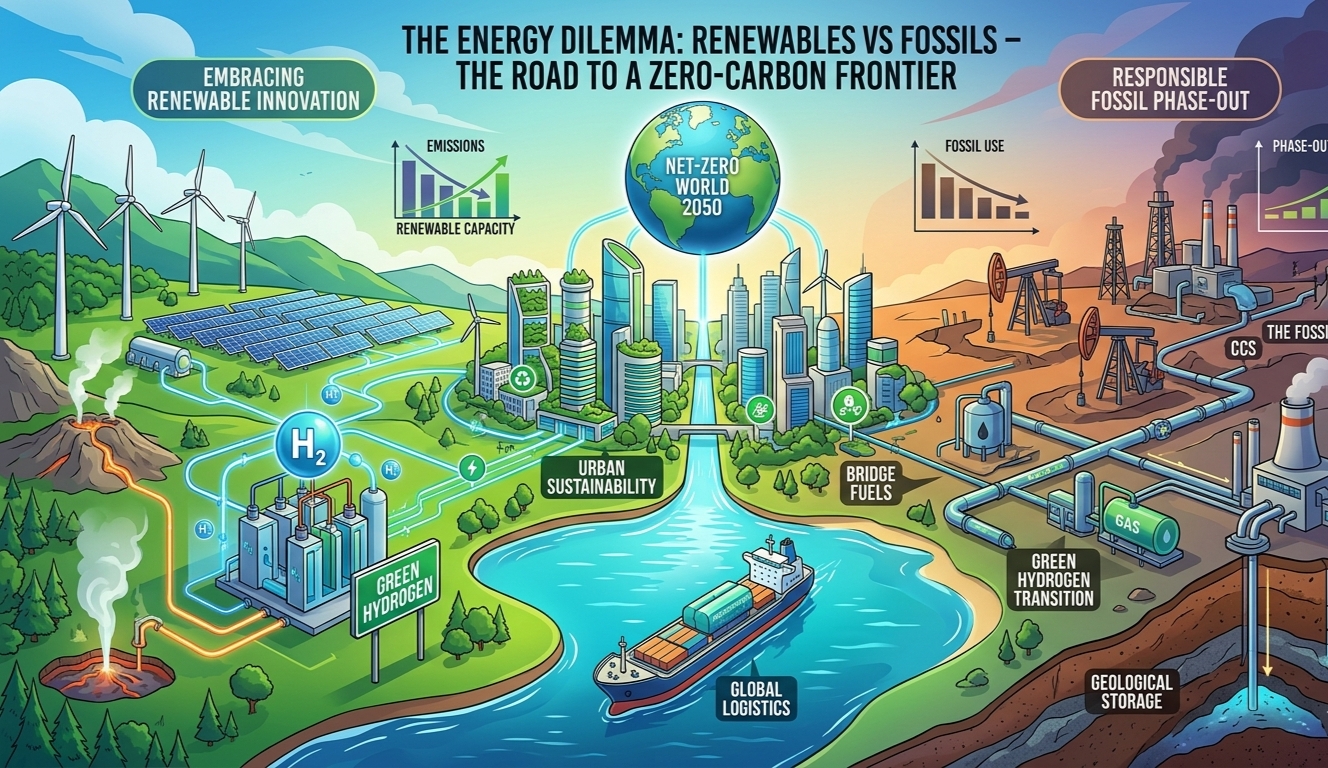
As the gears of the global economy grind against the limitations of our planetary boundaries, a singular question dominates the corridors of power: how do we fuel our future without torching our home? The debate between Renewable Energy and Fossil Fuels is no longer a mere academic exercise in thermodynamics; it is the definitive geopolitical and ethical struggle of the twenty-first century.
The Legacy of Hydrocarbons
For two centuries, fossil fuels — coal, oil, and gas — have been the bedrock of human advancement. Their energy density and established infrastructure provided the sheer horsepower required for the Industrial Revolution. Yet, this progress came with a hidden cost: an atmospheric carbon debt that is now being called in.
While “abated” fossil fuels via Carbon Capture and Storage (CCS) offer a transitional bridge, the era of unbridled hydrocarbon dominance is facing its twilight. The instruments of measurement are sharper than they have ever been; the patience of the public, sharper still.
The Rise of the Renewables
In the opposite corner stands the green vanguard — solar, wind, and the burgeoning promise of green hydrogen. These sources offer a tantalising prospect: an effectively infinite energy supply with a near-zero carbon footprint.
The plummeting costs of photovoltaics and electrolysis mean that being “green” is finally becoming “profitable.” The argument from virtue and the argument from cost have, almost for the first time, begun to converge.
We do not just need more energy. We need smarter energy.
The Verdict: Which Path Must We Choose?
The transition is not as simple as flipping a switch. The intermittency of wind and solar requires massive advancements in grid-scale storage and strategic intelligence. However, to achieve a truly carbon-free world, the mandate is clear, and it can be read in three sentences:
- Accelerated Decarbonisation. We must aggressively pivot toward renewables to meet Net-Zero targets. Half-measures are no longer politically credible, and they were never scientifically credible.
- Strategic Integration. Natural gas and hydrogen serve as high-density “bridge fuels” to maintain grid stability during the transition — provided the bridge is understood, by everyone holding its blueprints, to be temporary.
- Efficiency and Innovation. Investment in biophilic architecture, smart-city frameworks, and demand-side intelligence must run alongside the supply-side build. The cheapest kilowatt-hour is the one we never had to generate.
The Conclusion
We do not just need more energy; we need smarter energy. For a sustainable and dignified future, the global community must choose the path of renewable innovation while responsibly phasing out the carbon-heavy legacies of the past.
The honest editorial position, this paper has long maintained, is the one that does not flatter either side of the present debate. Renewables alone are not sufficient yet; fossil incumbency is no longer defensible. The art of the next decade will lie in walking, quickly, the narrow ridge between those two facts.
Key Takeaways
- Sustainability
- Green hydrogen is the “missing link” for heavy industry — steel, shipping, long-haul aviation — where direct electrification will not, in the foreseeable engineering, suffice.
- Economics
- The “green premium” is shrinking. For the first time in the modern era, renewables are also the most logical fiscal choice in most major markets.
- Legacy
- Decarbonising the existing fleet — refits, abatement, methodical retirement — is as vital as building new turbines. The transition is, in the end, an act of accountancy as much as engineering.
The cover story of this issue argued that the universe, the psyche, and global law are three answers to one question. The editorial argument is narrower, but of the same family. The question of how a curious species fuels its civilisation is a question of physics, of economics, and of treaty law — in that order, and at the same time. We mean to keep reporting on it that way.
———