The James Webb Space Telescope's deep-field view, in conversation with the classical canon and the architecture of international law.
— The Russell Civilizations Review · NASA / ESA / CSA composite
From the Editor · The Polymath's View
Three Inquiries, One Question
This issue is, by any honest accounting, three issues at once. The
James Webb Telescope's latest deep field is a fact about the
universe; the philosophical literature on selfhood is a
tradition about the human; the architecture of international
treaty law is a fiction we agree to keep believing.
We propose, modestly, that they are the same problem — the
problem of how a curious species writes a coherent story about itself
while standing inside the events being described. The answer, week by
week, is what this paper is for.
Treaty Architecture · A primer for the lay reader
Category
Source
Impact
Pacta Sunt Servanda
Treaties
Legal Certainty
Opinio Juris
Custom
Global Norms
Jus Cogens
Peremptory Norms
Universal Ethics
— Dr. Mostafa Kamal Russell · Editor-in-Chief & Founder
Opinion · Comment · LettersThe Polymath's View — the editorial pages of The Global Polymath, where the publication argues with itself in print.p. 22 — The Comment Desk
MKR
The Polymath's View · This Week's Editorial
By the Editorial Staff
Under the direction of Dr. Mostafa Kamal Russell · Editor-in-Chief
Editorial · Energy & the Climate Frontier
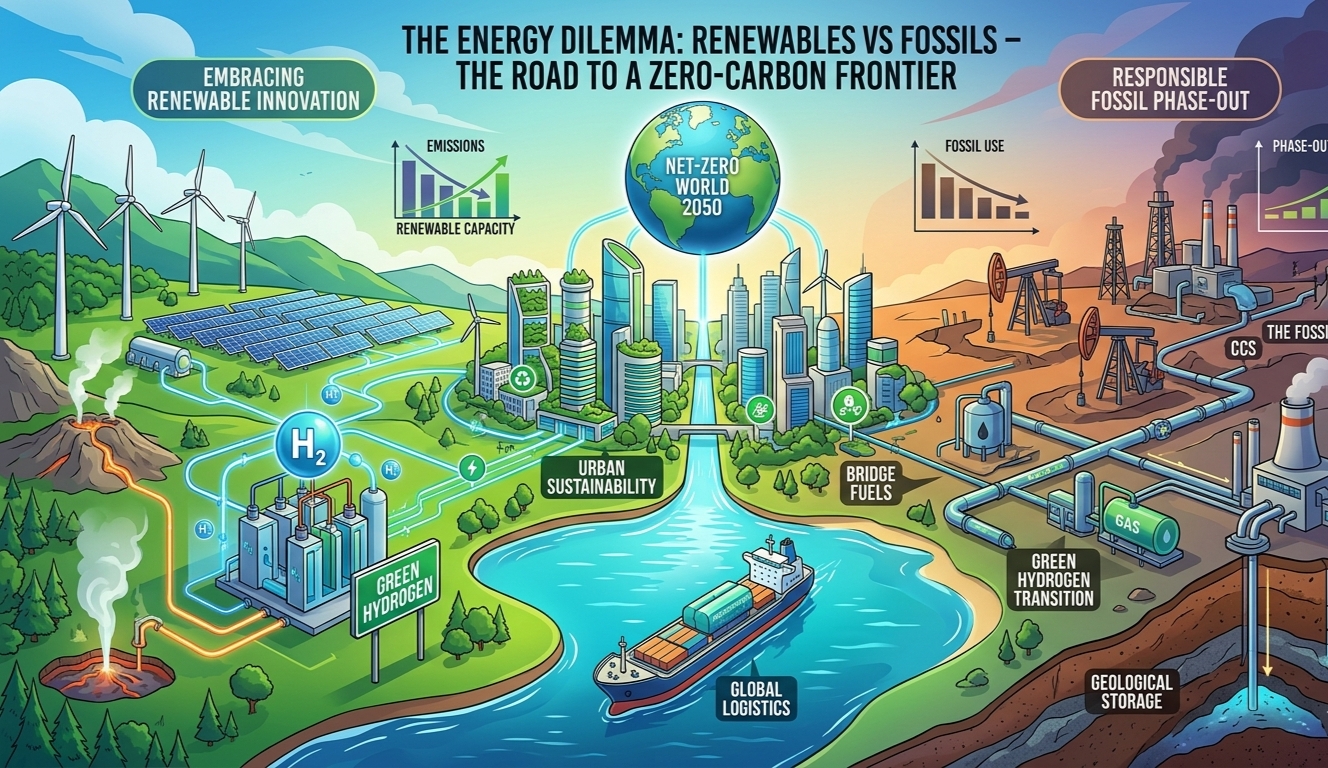
The Energy Dilemma: Renewables vs Fossils — The Road to a Zero-Carbon Frontier
As the gears of the global economy grind against the limitations of
our planetary boundaries, a singular question dominates the
corridors of power: how do we fuel our future without torching our
home? The debate between renewable energy and fossil fuels is no
longer an academic exercise in thermodynamics; it is the definitive
geopolitical and ethical struggle of the twenty-first century.
We do not just need more energy. We need smarter
energy.
For two centuries, fossil fuels have been the bedrock of human
advancement — and the source of an atmospheric carbon debt
that is now being called in. The green vanguard, meanwhile, has
moved from idealism to fiscal logic: the plummeting costs of
photovoltaics and electrolysis mean that being “green”
is finally becoming “profitable.”
The honest editorial position is not the one that flatters either
side of the present debate. Renewables alone are not yet
sufficient; fossil incumbency is no longer defensible. The art of
the next decade will lie in walking, quickly, the narrow ridge
between those two facts.
The freedom to evade is the only freedom a system without
consciousness cannot exercise. That is, this column suspects, the
most useful sentence anyone has yet written about machine learning.
We have replaced Freud's vocabulary three times in a hundred
years and his question once. The question, on inspection, is the
only thing in the file that has held its value.
Outer-space law was a curiosity in 1967 and a hobby in 2007. The
Webb instrument has, almost as a side effect, made it the most
practical question in the field.
Upon this day, my heart finds voice to speak,Of love that grew in silence, deep and true.No fleeting whim, nor fancy do I seek,But all my soul's devotion, bound to you…
The Polymath's Challenge · Weekly Quiz
Three questions for the discerning reader
The first ten readers to submit three correct answers are named in next week's colophon.
Who coined the phrase "existence precedes essence"?
What is the primary mirror diameter of the JWST?
Which Roman principle dictates that treaties must be honoured?